
 Attendees experienced a concert like no other — one that combines breathtaking new music, gorgeous vineyard views, and a chance to meet the rising stars shaping tomorrow’s musical landscape. Winning Scores took place Sunday, October 25th, 3:00 PM at the Bella Rosa, Garré Vineyard & Winery in Livermore.
Attendees enjoyed five stunning world premieres, hand-picked by an esteemed panel for their beauty, emotion, and resonance. The music is fresh yet relatable, composed by some of the most gifted young artists in the country, all in their 20s and 30s.
These are not experimental soundscapes or abstract exercises; they are vivid, heartfelt works that reflect the composers’ lives, dreams, and cultural roots. The engaging Q&A with the composers gave the audience the opportunity to learn more about their music and inspiration.
Following the Q&A patrons enjoyed a Gala Dinner with the composers, with conversation, fine cuisine, and shared treasured moments.
“It was a thrill for the audience to hear these premieres, unveiled for them,” said Music Director Lawrence Kohl. “The audience wasn’t just listening; they were part of making history. The audience is essential in helping to launch these emerging star composers who will shape the future and directions of classical orchestral music.”
Meet the composers
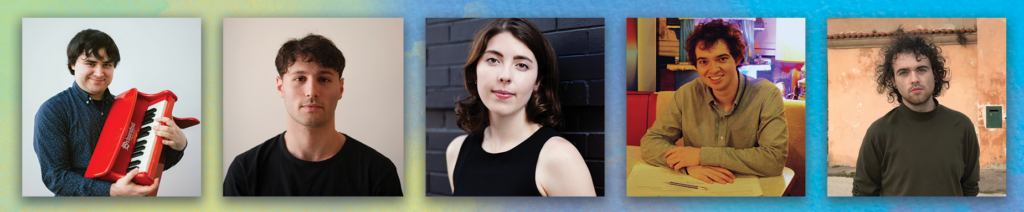
Aidan Gold
Benjamin Edelson
Flannery Cunningham
Julian Stuart-Burns
Samuel Long
Aidan Gold is a composer, conductor, percussionist, and educator. His work often focuses on musical games, improvisation, theatricality, and narrative/storytelling. He is fascinated with the idea of music as a social act – a game/ritual that we perform to allow us to communicate and connect with one another, defining, challenging, and expanding our individual and collective identities.
Gold has a DMA in Composition at the Juilliard School. His music has been performed by the Juilliard Orchestra, the JACK Quartet, the Chelsea Symphony, and others, and has won awards including the Arthur Friedman and Palmer Dixon prizes.
Gold is passionate about collaborating to create new kinds of performance. He is one of the founding members of AFK, a NYC contemporary chamber music collective that focuses on creating interactive musical experiences. His other interests include origami and hiking. Gold grew up hiking and climbing in the Cascade mountains with his family. He was always fascinated by the immense scale and interconnectedness of the natural world and its broad and diverse ecosystems. His compositional goals are to support these connections, exploring new ways we can interact with each other while making music, and how these multifaceted connections can enrich our communities.
Flannery Cunningham is a composer fascinated by vocal expression, text, and auditory perception. She aims to write music that surprises and delights. Called “silken” by The Washington Post, her work has been performed at festivals such as Aspen, June in Buffalo, Toronto Creative Music Lab, SPLICE Institute and Festival, and Copland House’s CULTIVATE and by performers such as International Contemporary Ensemble, PRISM Quartet, TAK, New York New Music Ensemble, Yarn/Wire, and Music from Copland House. She has held residencies at Craters of the Moon National Monument, Atlantic Center for the Arts, and Copland House.
In addition to acoustic ensembles she writes for players and singers with interactive electronics, always striving to foreground the musicality of human performers. Her debut chamber opera Groundwater (staged premiere 2025 with Thompson Street Opera) was inspired by Rachel Carson’s Silent Spring and treats groundwater as both an environmental issue and metaphor for memory, drawing on field recordings, feedback loops of sight and sound, and interactions between digital and physical materials.
Originally from central Minnesota, Flannery holds degrees from Princeton University, University College Cork, and Stony Brook University as well as a joint PhD in composition and musicology from the University of Pennsylvania.
A Dutch-Cuban composer & pianist, Julian Stuart-Burns writes music torn between method and spontaneity. His works focus on musical ekphrasis, sharp and unexpected contrast, and on drawing connections with literature. His writing is informed by his experience in organized labor and by Cuban revolutionary history.
Julian’s work has been selected for Cambiata Arts’ Phantomnesis project, he was awarded the 2025 Bernard Rogers Memorial Prize for his piano sonata Toward the Surface, and his sinfonietta piece In a Few won a Belle S. Gitelman Award in 2024. His pieces have been performed by CAMP, Contemporaneous, Ensemble Suono Giallo, Mivos Quartet, loadbang, members of Talea Ensemble, and Musica Nova.
An avid teacher, Julian has taught composition and music theory at Eastman School of Music and Eastman Community Music School. Having received his M.A. in composition from Eastman, Julian is currently a labor organizer at 1199SEIU, the United States’ largest healthcare union.
Samuel Long is a Boston-based composer and improviser, composing in extended just intonation. He has written for ensembles including the Lydian String Quartet, Talea, Hypercube, and Lamnth. Samuel was one of 10 composers selected by IRCAM to perform with and study under Bernhard Lang at the 2022 ManiFeste festival in Paris. In 2024, he was a fellow at the Etchings Festival in New York City and gave the first live performance on a 1960s Buchla synthesizer as a fellow of the Leonard Bernstein Festival of the Arts. He performed at the 2025 Darmstadt Summer Courses.
He received an MFA in Music Theory and Composition at Brandeis University, where he was awarded the Fischer Prize for Excellence in the Creative Arts. He studied privately with La Monte Young and Catherine Lamb, and currently attends Boston University for his DMA.
Keep reading, there’s more to discover!
“Winning Scores” isn’t experimental or intimidating. It’s immersive, inviting, and genuinely exciting. These works were crafted to draw you in with emotion, color, and musical storytelling you can follow and feel. The orchestra surrounds the audience with sound, and they feel part of the ensemble. Before each piece, Maestro Kohl introduced what to listen for, giving a personal entry point into every premiere.
These are tomorrow’s great composers — and the audience got to hear their music, meet them in person, and discover what drives them. The composers are listening, too! The audience reactions and questions in the post-concert Q&A gave them insight that will influence their work going forward.
This was more than a concert. It was a shared journey where new music becomes personal, exciting, and unforgettable. The audience came curious and left inspired.